Blog Post 2: Applying Inquiry-Based Learning to Photography
Understanding Inquiry-Based Learning
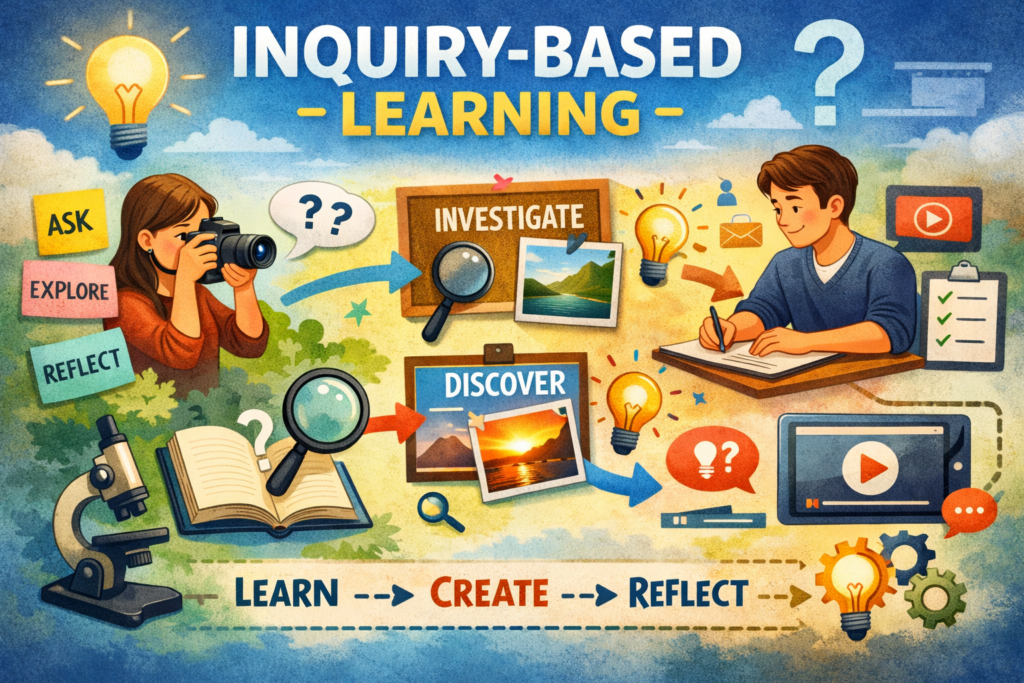
Inquiry-based learning is an instructional approach that emphasizes learning through questioning, exploration, and active engagement rather than passive information intake. Instead of providing learners with all the answers, this approach encourages them to investigate concepts, test ideas, and reflect on their experiences. Inquiry-based learning is closely connected to constructivist theory, which suggests that learners build knowledge by actively adjusting their mental models in response to new experiences (Hmelo-Silver, Duncan, & Chinn, 2007).
What stood out to me while reading about inquiry-based learning is how much responsibility it places on the learner. Rather than memorizing content, learners are required to think critically, make decisions, and learn from mistakes. This makes learning feel more meaningful, but also more challenging.
Why Inquiry-Based Learning Fits Photography
Inquiry-based learning aligns strongly with our group’s chosen topic of photography for beginners. Photography is not something that can be mastered simply by reading instructions or watching tutorials. Understanding concepts such as lighting, color, and composition requires experimentation and observation. For example, learners can be asked to take multiple photos under different lighting conditions and analyze how light direction or color temperature affects mood and clarity. Through this process, learners actively construct understanding rather than passively receiving information.
From my own experience, I have learned far more about photography by experimenting with settings and reflecting on outcomes than by reading technical explanations alone. Inquiry-based learning mirrors this natural learning process and allows learners to connect theory with real-world practice (Prince & Felder, 2006).
The Role of Technology in Supporting Inquiry
In technology-mediated environments, learning approaches are not neutral. The tools we choose directly shape how learning occurs. Platforms such as WordPress, smartphones, and basic photo-editing software support inquiry-based learning by allowing learners to document their work, share images, and reflect on their decisions. These tools encourage exploration, creativity, and peer interaction rather than simple content consumption.
However, inquiry-based learning also requires thoughtful structure. Without guidance, beginners may feel overwhelmed or unsure where to begin. For this reason, our learning resource would balance inquiry with scaffolding through guiding questions, examples, and clear assessment criteria (Kirschner, Sweller, & Clark, 2006).
References
Hmelo-Silver, C. E., Duncan, R. G., & Chinn, C. A. (2007). Scaffolding and achievement in problem-based and inquiry learning: A response to Kirschner, Sweller, and Clark. Educational Psychologist, 42(2), 99–107. https://doi.org/10.1080/00461520701263368
Kirschner, P. A., Sweller, J., & Clark, R. E. (2006). Why minimal guidance during instruction does not work. Educational Psychologist, 41(2), 75–86. https://doi.org/10.1207/s15326985ep4102_1
Prince, M., & Felder, R. (2006). Inductive teaching and learning methods: Definitions, comparisons, and research bases. Journal of Engineering Education, 95(2), 123–138. https://doi.org/10.1002/j.2168-9830.2006.tb00884.x
Hi Sananth,
I really liked how clearly you explained inquiry based learning and connected it to photography. Your example of experimenting with different lighting conditions was a strong illustration of how learners build understanding through exploration rather than memorization.
I also appreciated that you acknowledged the need for scaffolding. Bringing in the idea that beginners can feel overwhelmed without guidance shows you are thinking critically about balance. Inquiry can be powerful, but only when it is structured thoughtfully.
Your post made me reflect on how important tool choices are in technology-mediated environments. Platforms like WordPress or editing software can support inquiry, but only if tasks are designed intentionally.
Overall, you made a strong and balanced argument for why inquiry-based learning fits photography.